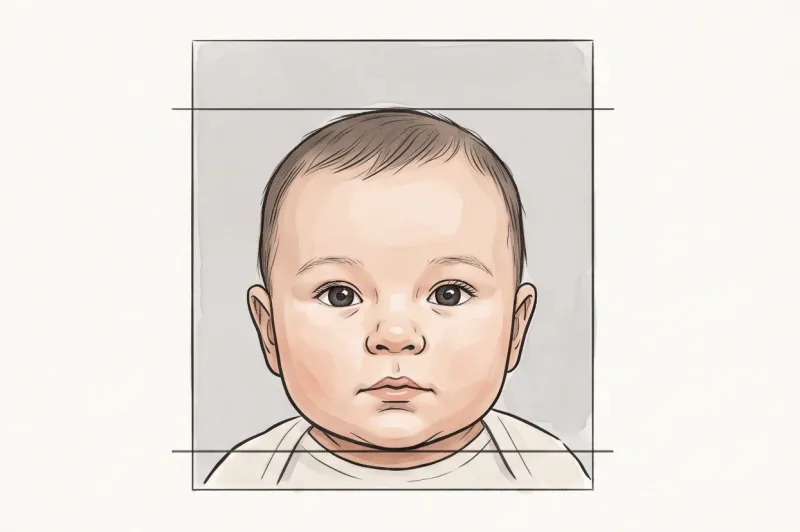
What are the rules for an infant passport picture?
Every infant, no matter how young, needs their own official biometric picture to cross international borders. While trying to capture a compliant infant passport photo can feel daunting, the good news is that most immigration departments understand that babies are not cooperative adults. The core rules for an infant's picture mirror standard adult requirements: the baby must face straight to the camera against a plain, light background, with even lighting, and absolutely no other people or objects in the frame. However, strict biometric rules regarding perfectly neutral expressions and fully visible eyes are generally relaxed for newborns.
Ready to make one? Create a compliant baby or infant passport photo from a home snapshot — no studio trip needed.
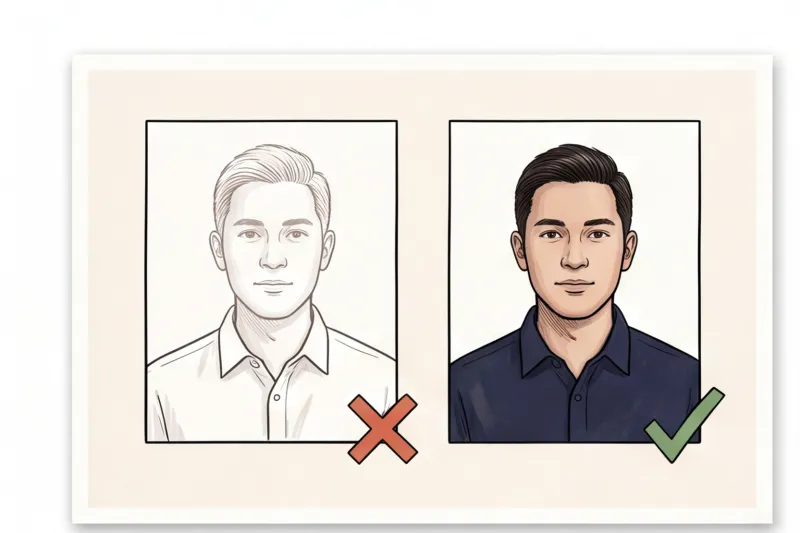
International machine-readable travel document standards are built on ICAO Doc 9303. This global baseline establishes the universal biometric rules that apply to everyone, regardless of age. For an infant, this means the face must be positioned straight toward the camera, with the head centred and looking directly at the lens. The photo must feature a plain, light, uniform background — typically plain white or light grey — with no patterns, textures, or distracting colours. Even lighting is non-negotiable; there must be no harsh shadows falling across the baby’s face, no red-eye, and no dark drop-shadows cast on the background. You can see how these baseline rules apply broadly across all ages in our complete guide to global passport photo requirements.
While authorities are lenient about a baby's expression, certain biometric violations guarantee an automatic rejection. In practice, the most common reason a baby's photo is rejected is the presence of foreign objects or supporting hands. There are absolute bans you must observe: no dummies or pacifiers in the mouth, and no toys or blankets obscuring the face or neck. Crucially, there must be strictly no other people in the frame. This includes a parent’s hands, fingers, or arms being visible while trying to support the baby's wobbly head.
Eyes Open or Closed: Navigating Newborn Exceptions
The most frequent question parents ask is whether a sleeping baby’s picture is valid. The answer requires drawing a line between young children and infants. For young children and toddlers, authorities generally enforce standard adult rules: the child must have their eyes open, look directly at the camera, and keep their mouth closed where physically possible.
Newborns, however, fall under special exceptions. National authorities — such as the U.S. Department of State or GOV.UK — adjust their enforcement of ICAO guidelines for very young babies. Many countries explicitly accept photos of newborns with their eyes partially or completely closed, provided all other technical criteria like head positioning and background clarity are met. The strict requirement for a perfectly neutral expression is also frequently waived; a newborn with their mouth slightly open will usually pass the compliance checks.
Because these age cut-offs and specific allowances vary by nation, you should always check the specific destination country's official authority to confirm their exact policy on infant exceptions. Finally, if you photograph your baby while they are asleep, submit the image exactly as it was captured. Never use digital manipulation or editing software in an attempt to artificially "open" your baby's eyes or erase blemishes. Any obvious retouching or digital alteration will immediately invalidate the picture.
What will get an infant passport photo rejected?
An infant passport photo will be rejected if a parent's hands or arms are visible supporting the child, the background is patterned or textured, harsh shadows obscure the face, or prohibited items like dummies and large bows are worn. While immigration authorities understand that babies are difficult to photograph, they strictly enforce these core biometric rules.
In practice, the visible hand or fingers under the baby's shirt is the most common reason for rejection we see. Parents naturally try to prop up a newborn's head or hold their shoulders steady. However, the rules explicitly state that absolutely no other person — nor any part of another person — can appear in the frame. If a stray finger or supporting arm is visible, the photo will fail.
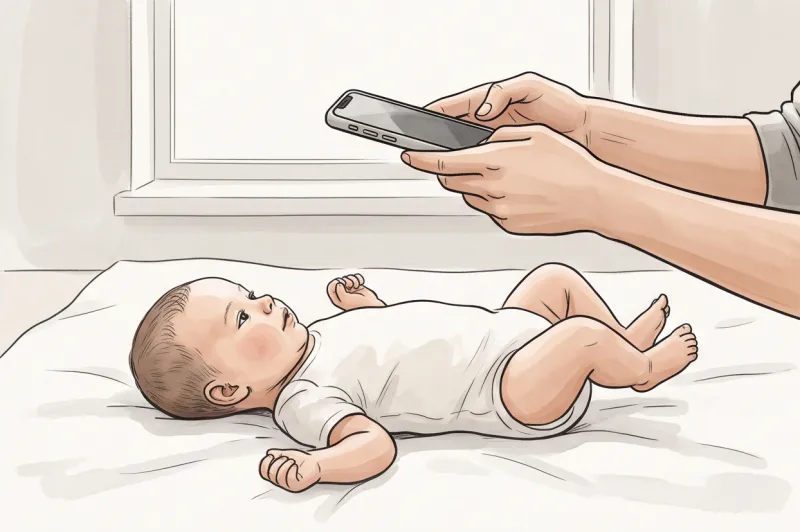
Background failures are the second major hurdle. When photographing at home, parents frequently use baby blankets. If that blanket has a visible woven texture, a repeating pattern, or is any colour other than a plain, uniform white or light grey, the photo will not meet the official technical requirements. The surface must be completely plain and light.
Lighting mistakes often happen simultaneously. When laying a baby down, a parent typically leans over the lens to capture the shot. This casts a distinct, heavy shadow directly onto the baby's face or onto the blanket behind their head. Even lighting with no harsh shadows is a universal biometric requirement. For a broader look at international standards and how they apply across different countries, check our complete guide on global passport photo requirements.
Finally, appearance items frequently cause unnecessary rejections. When preparing your baby for the photo, you must remove the following:
- Dummies and pacifiers: The mouth must be clearly visible.
- Headbands and large bows: Prominent accessories that obscure the face outline or cast shadows are prohibited.
- Hats and head coverings: These are strictly banned unless worn for documented religious or medical reasons, in which case the full face from the bottom of the chin to the forehead must remain completely visible.
- Toys: No teething rings, cuddly toys, or hands holding toys can be in the shot.
Get your document photo in 2 minutes
Upload a normal selfie and receive a compliant document photo that meets the official technical requirements for your country and document — ready to print or submit online.
Make my photoHow to take a newborn passport photo at home
To successfully take a newborn passport photo at home, lay your baby flat on a plain, light-coloured sheet or drape a white cloth over a car seat. Place them facing a large window for even, natural light, and hold a toy directly behind the camera lens to draw their gaze.
In practice, the easiest method for infants who cannot yet hold their heads up is the "lay flat" technique. Place a plain white or light grey blanket, or a bedsheet, securely on the floor or a firm mattress. Lay the baby flat on their back. It is critical that the fabric is uniform in colour and smoothed out to remove deep wrinkles or shadows. Stand directly over the baby to take the photo, ensuring the camera is perfectly parallel to their face.
For an older infant who is starting to sit up or has better neck control, the car seat alternative often yields better results. Drape a plain white or light grey sheet entirely over the car seat, ensuring it covers the straps and padding, and secure your baby in the seat. This safely props the child up and automatically satisfies the rule that no parent’s hands or arms can support the child in the frame.
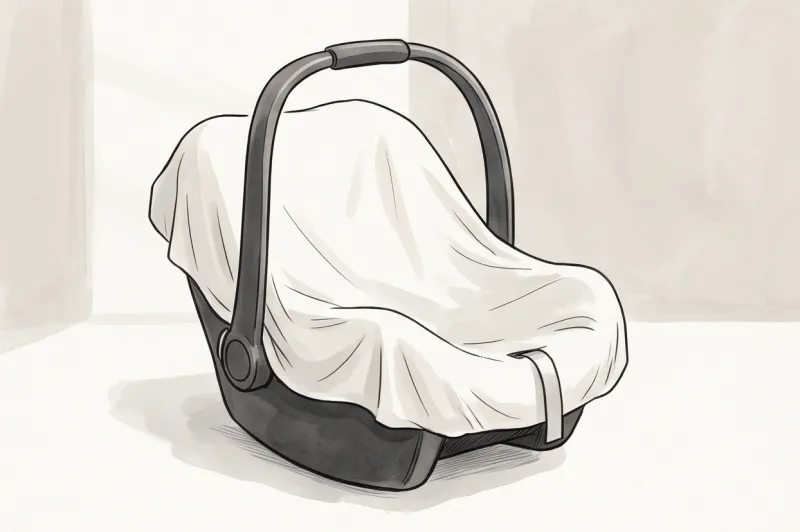
Lighting is where most home shoots succeed or fail. Position the baby near a large window to utilise even, natural daylight. Avoid placing them in direct, harsh sunlight, as this will cause the infant to squint and create the very shadows on the face or background that authorities reject. When leaning over the baby, check that your own body is not casting a shadow over the lens or onto the child’s face.
To get the required straight-on gaze, use a capture strategy that grabs their attention at the exact right moment. Squeak a small toy or wave a brightly coloured object directly behind your smartphone or camera lens. Remember to keep the toy completely out of the frame. Because babies move unpredictably, use your camera’s burst mode to take dozens of photos in rapid succession. Once you have a clear shot, resist the urge to edit it. Never apply digital filters, skin-smoothing beautification apps, or obvious retouching. Biometric photo standards strictly forbid digital manipulation; the photo must remain an unaltered, true likeness of your baby.
Your main objective at home is simply to capture a clear, well-lit image of the baby on the correct background. Do not worry about cropping the image to exact sizing rules or getting the head-to-height ratio perfect. You can upload your raw, unedited photo to PhotoID24, and our professional service will automatically crop and format the picture so it meets the official technical requirements of your destination country in about two minutes.
Do babies need to comply with adult makeup and glasses rules?
Yes — the strict biometric rules regarding digital beautification, glasses, and face-obscuring accessories apply just as strongly to infants as they do to adults. While parents are obviously not applying makeup to a newborn, the core principle remains the same: the child's natural appearance cannot be altered or hidden in an infant passport photo.
For babies, the "makeup" rule directly translates to a strict ban on digital filters. In practice, a frequent mistake is taking the photo using default smartphone portrait modes that automatically smooth a baby's skin or artificially brighten their eyes. This constitutes digital manipulation. Official authorities require natural skin tones, and any heavy editing or beautification filter will result in an immediate rejection. While removing a temporary scratch or blemish digitally is generally acceptable, altering features or smoothing skin textures is not.
When it comes to eyewear, glasses are increasingly banned in passport photos globally. Authorities in the UK and most of the EU, for example, have eliminated them entirely from standard document photos. If your baby wears glasses for a documented medical reason, you must check the specific destination country's exception rules. If they are permitted, you must ensure the eyes are fully visible, the frames do not cross the eye line, and there is absolutely no lens glare or reflection.
Finally, all prominent accessories must be removed before you take the shot. Items like oversized bows, thick headbands, bulky hair clips, or headphones distort the natural face outline. To meet the official technical requirements, the full face must be visible from the bottom of the chin to the forehead, with no objects casting shadows or breaking the head's silhouette.
Ready to prepare your document photo?
Skip the studio. Upload a selfie and get a professionally prepared photo that meets the official technical requirements in about two minutes.
Get startedHow do I make a 2x2 photo (or 35x45 mm) for my baby's passport?
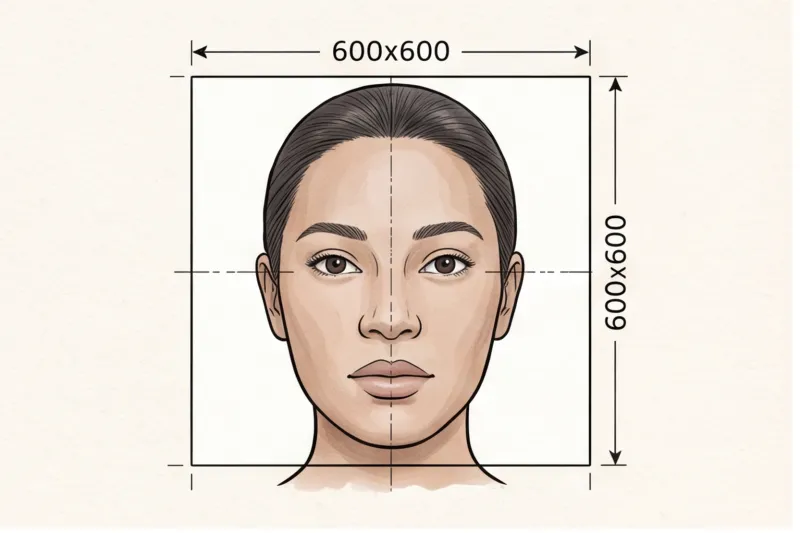
To make the correctly sized photo for your baby, you must first confirm the precise dimensions dictated by the issuing government, as there is no universal global size. Do not guess the format. For example, the United States strictly requires a 2x2 inch (51x51 mm) image for its documents, whereas the United Kingdom and the majority of European countries use a 35x45 mm standard.
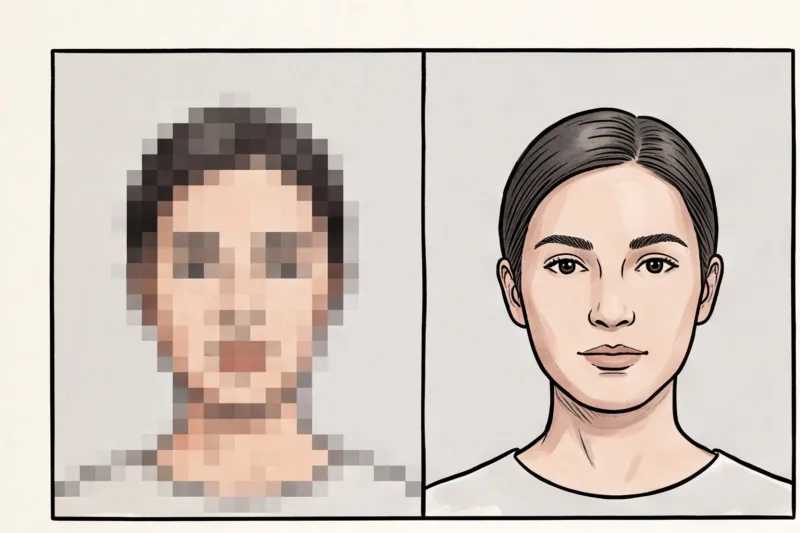
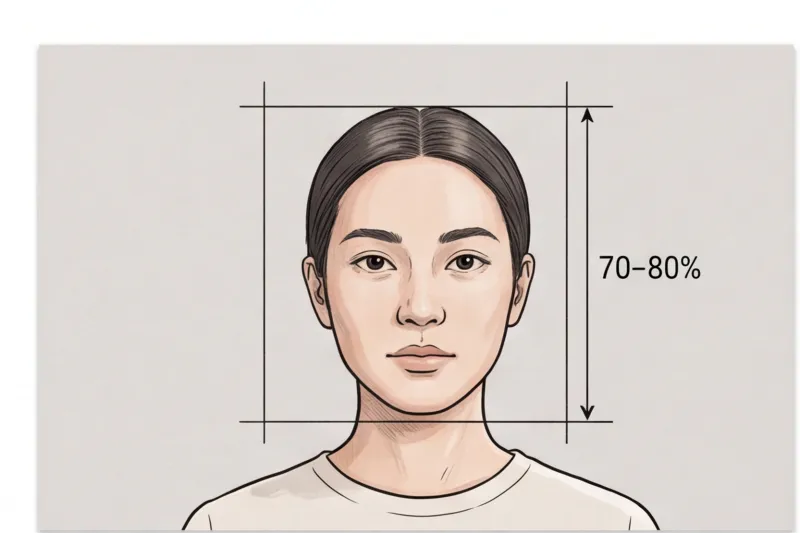
Even after confirming the outer dimensions, formatting the image at home is risky. Cropping a baby's photo manually is difficult because the head-to-height ratio must be perfect. Most biometric standards dictate that the face must fill roughly 70–80% of the total frame height. Measuring from the bottom of a newborn's chin to the crown of their head is complicated by their natural proportions and posture. If you get this ratio wrong, the photo will fail the official technical review.
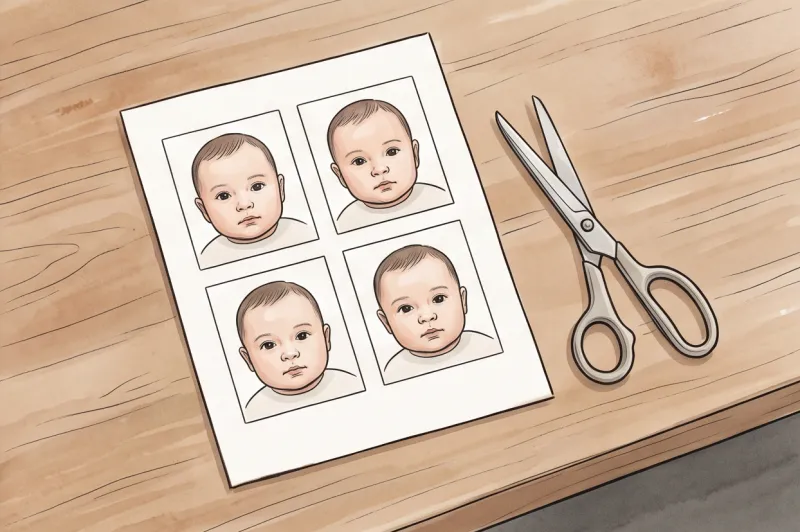
The most reliable way to avoid these sizing rejections is to use PhotoID24. You do not need a professional studio setup or complex desktop editing software. Simply take a photo of your baby lying flat on a plain white or light grey sheet with your smartphone, ensuring they are facing the camera and the lighting is even. Then, upload that original, unedited image directly to our service.
In about two minutes, PhotoID24 automatically formats the photo to meet the official technical requirements of your specific country and document type. The service meticulously checks the image against the precise biometric rules, perfects the head-to-height ratio, and prepares a compliant digital file for online applications or a correctly sized print sheet. This ensures your baby's photo is technically accurate and entirely ready for submission.
The Final Checklist for Infant Document Photos
A compliant infant document photo must be taken within the last six months and feature your baby entirely alone against a plain, light background with even lighting and zero shadows. In practice, missing just one of these minor details—like a stray pacifier or a visible parent's finger—is enough to trigger an automatic rejection from passport authorities.
Before you finalize your submission, run your chosen image against this strict biometric checklist to ensure it meets the official technical requirements:
- Recent photo (within 6 months): Official guidelines dictate that the image must reflect the applicant's current appearance, typically requiring it to be taken within the last six months. For adult passports, minor changes are expected, but for babies, this rule is absolute. A newborn's facial structure develops rapidly; a photo taken at two weeks old will not reflect an eight-month-old baby crossing a border. Always capture the image immediately before submitting the application.
- Plain, light background with no wrinkles: The space behind your baby's head must be completely plain, uniform, and light—usually pure white or light grey, depending on the specific country's official standard. Verify that the blanket or sheet used is pulled entirely flat. Deep wrinkles, heavy textures, or stray objects in the background disrupt the biometric cropping process.
- No hands or parents visible: Verify that absolutely no part of a parent is in the shot. A typical mistake when shooting at home is a well-meaning parent's hand entering the frame to hold the infant still or support their neck. If your child cannot sit up independently, rely entirely on the flat surface beneath them to provide support.
- No pacifiers, toys, or large headwear: The biometric focus must be solely on the child's facial features. Double-check that no dummies, teething toys, or large headbands are present. Prominent accessories obscure the natural outline of the baby's head. Head coverings are permitted only for documented religious or medical reasons; even then, the face must be fully visible from the bottom of the chin to the top of the forehead.
- Even lighting with no shadows: Inspect the final image for dark patches. Lighting must be even across the entire face. A frequent error is the photographer casting a distinct shadow over the baby while holding the smartphone directly above them. Ensure the light source illuminates the baby evenly, leaving no dark patches on their cheeks or sharp shadows on the blanket behind their head.
Your clear action step for today is to prepare your shooting environment. Find a room with a large window, stretch a plain white or light grey sheet tightly across a flat, safe surface, and take your photos while indirect daylight is at its brightest. Once you have a clear shot of your baby looking upwards, you can format it immediately without worrying about complex manual cropping.
Get your document photo in 2 minutes
Upload a normal selfie and receive a compliant document photo that meets the official technical requirements for your country and document — ready to print or submit online.
Make my photo