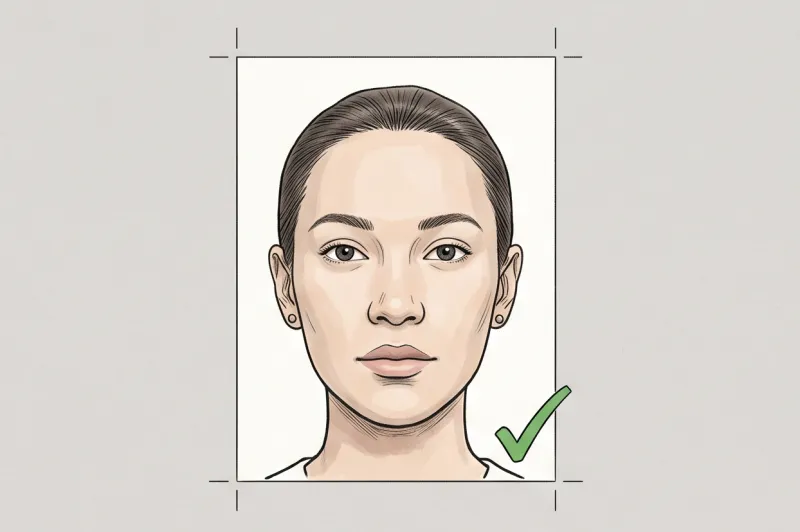
Can You Wear Earrings in a Passport Photo?
If you are asking, "can you wear earrings in a passport photo?", the direct answer is yes. In most countries, you can wear earrings, but doing so comes with strict biometric risks. A single flash reflection off a silver hoop is enough to invalidate an otherwise perfect image.
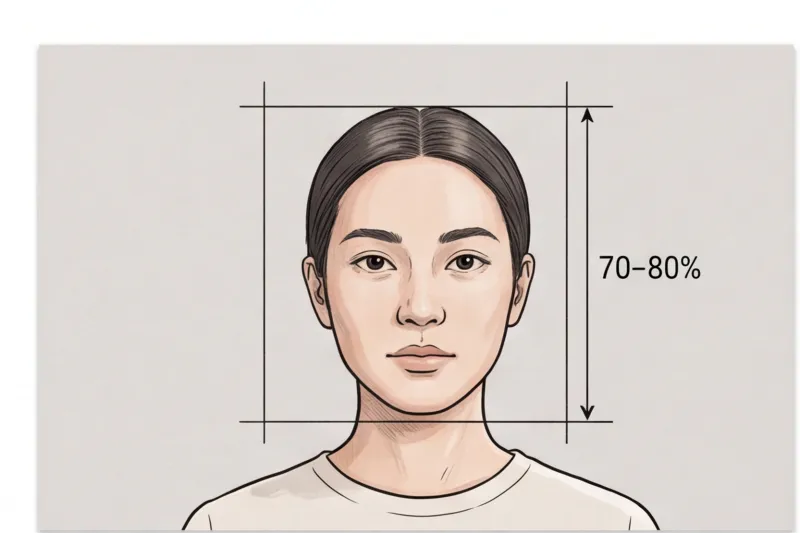
Official guidelines from authorities such as the U.S. Department of State and the UK's GOV.UK do not expressly forbid jewelry. You are generally permitted to wear everyday accessories, provided they do not hide any part of your face. This aligns with the golden rule established in the international machine-readable travel document standard, ICAO Doc 9303: the facial outline — from the bottom of the chin to the top of the forehead, and edge-to-edge along the jawline — must be 100% visible. We cover how these baseline standards shape national policies in our complete guide to global passport photo requirements.
Because specific interpretations vary by country, checking the official national authority for your specific document is paramount. In our experience checking document photos, the accessory itself is rarely the primary issue. Rejections typically stem from the photographic side effects: shiny metals bouncing glare back into the camera, or dangling pieces casting visible shadows on the neck or the plain background. Therefore, while small, matte studs are usually fine, the safest approach to ensure your photo meets official technical requirements is to remove all jewelry before taking your picture.
What Will Get a Passport Photo Rejected Due to Jewelry?
Passport photos are rarely rejected simply because a piece of jewelry is present; rather, they are rejected because the jewelry creates secondary photographic side effects like shadows, glare, or an obscured facial outline. In practice, authorities use automatic biometric scanners to map specific facial landmarks, such as the exact edge of your jawline and the distance between your facial features. When accessories interfere with these data points, the processing system immediately flags the image as non-compliant.
We cover the full technical specifications in our complete guide, but when it comes to accessories, rejections almost always fall into one of three specific categories:
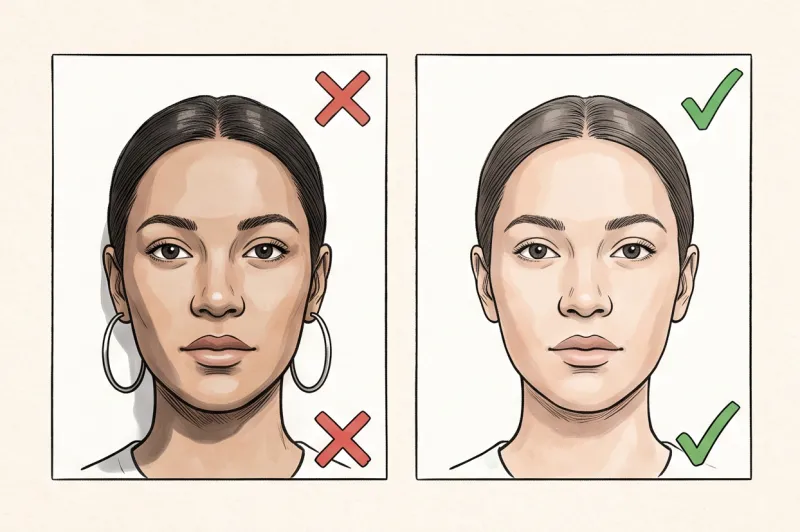
- Prominent jewellery obscuring the face: Large hoops, chandelier earrings, or chunky necklaces that break the natural line of the jaw or cheeks are strictly prohibited. ICAO Doc 9303 and national standards require your facial outline to be 100% visible. If an earring is so large that it covers part of your cheek or extends past the jawline, the biometric software cannot accurately map your face shape.
- Glare and reflections: Shiny metals, polished silver, and faceted gemstones bounce light back into the camera lens. This violates the universal requirement for even lighting and no glare. When a camera flash hits a reflective surface, it creates a bright white flare on the image, altering the exposure and causing a low technical quality rejection.
- Shadows: Dangling earrings or thick chains routinely cast sharp, visible shadows on the neck, the face, or the plain light background behind the applicant. Because the background must remain completely uniform and shadow-free, any shadow cast by a piece of jewelry immediately renders the photo invalid.
Get your document photo in 2 minutes
Upload a normal selfie and receive a compliant document photo that meets the official technical requirements for your country and document — ready to print or submit online.
Make my photoNose Rings, Lip Rings, and Facial Piercings
Permanent or semi-permanent facial piercings are generally accepted in passport photos, provided they do not hide the underlying structure of your face. A small, matte nose stud will usually pass without issue, assuming it does not catch the light.
However, you must exercise extreme caution with larger jewelry. Warn against wearing large septum rings or thick lip rings that obscure the mouth. Universal biometric rules mandate a neutral expression with the mouth closed and the lips entirely visible. If a piercing covers the line of your mouth or changes its natural resting shape, the application will be delayed.
We strongly advise removing any easily detachable piercings before taking your photo. Doing so completely eliminates the risk of a metallic glare bouncing off the jewelry into the lens, ensuring the image meets the strict lighting requirements on the first attempt.
What Are the Rules for a Passport Picture Regarding Necklaces?
Necklaces are permitted in passport photos as long as they do not obscure your neck completely or creep up to cover your chin and jawline. In practice, the safest approach is to wear a thin, non-reflective chain or remove the necklace entirely to prevent lighting issues.
Global biometric principles require even lighting with absolutely no shadows on the face, neck, or the plain, light background behind you. A thick chain or a large, chunky pendant easily catches overhead light, casting heavy, visible shadows on your upper chest or neck area. Furthermore, if a bulky choker or layered necklace sits too high and breaks the natural edge-to-edge outline of your lower jaw, the facial recognition software cannot accurately map your features, leading to a rejected application.
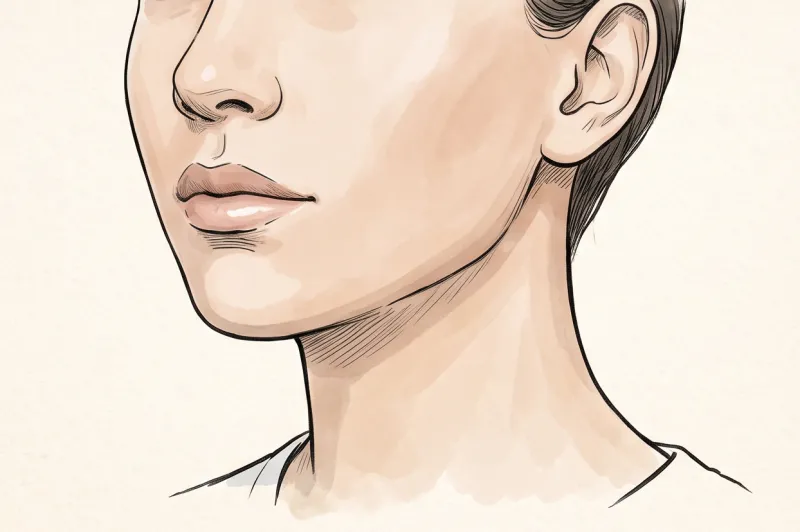
If you choose to wear a necklace, opt for a delicate piece that sits flat against your skin. The most practical solution when taking a photo at home is to simply tuck the necklace under your shirt line just before the camera clicks. This guarantees your neck area remains completely clear and ensures you easily meet the strict requirement for shadow-free lighting.
What Are the Passport Photo Requirements for Makeup?
You can wear makeup in a passport photo, provided it is natural and does not alter your true appearance or natural skin tones. Biometric systems map the exact geometry of your face, so heavy cosmetics that significantly change how you look on a daily basis will lead to an automatic rejection. Ensure your foundation matches your neck and chest to maintain the required natural color balance.
When selecting your makeup, you must avoid the same photographic hazards caused by metal accessories. High-shine highlighters, glitter-based powders, and highly reflective lip glosses should be left out of your routine. Under the bright, even lighting required for official document photos, glossy makeup mimics the exact glare issues caused by metallic jewelry. If studio lighting bounces off your cheekbones or lips and creates white spots or flares in the image, it violates the strict rule against glare and reflections. Matte finishes are always the safest choice.
Crucially, you must never rely on software to enhance your appearance. The international biometric guidelines strictly mandate no filters, no digital beautification, and no heavy retouching. While physically covering a temporary blemish with concealer before the photo is perfectly acceptable, using contouring techniques or digital apps to reshape your jawline, thin your nose, or smooth your skin is prohibited. In practice, obvious digital manipulation is a highly frequent reason for photo rejection. Your photo must be a true, unedited reflection of you.
Ready to prepare your document photo?
Skip the studio. Upload a selfie and get a professionally prepared photo that meets the official technical requirements in about two minutes.
Get startedHow Do I Make a Compliant Photo at Home with Accessories?
To successfully take a compliant passport photo at home while wearing accessories, you must balance perfectly even lighting with strict biometric rules — specifically a neutral expression, a clear background, and exact dimensions based on your specific country's official guidelines.
When setting up your shot, stand roughly 1 to 2 feet away from a plain, light, uniform background, such as a white or light grey wall. This physical distance prevents your body, and any jewelry you choose to wear, from casting visible shadows behind your head. Position yourself facing straight to the camera with your head perfectly centered. You must maintain a neutral expression with your mouth closed and no smile. Both eyes need to be open and clearly visible, with your shoulders square and your head level.
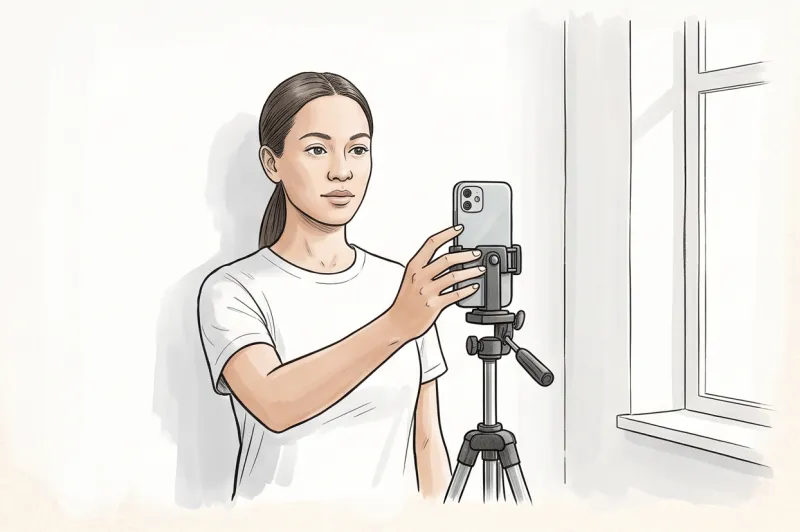
Ensure the lighting is perfectly even in front of you. A frequent issue with photos taken at home is relying on a single overhead bulb or a side window, which creates harsh contrast. If you insist on wearing small studs, carefully review your test shots. Zoom in closely to check for any white flare bouncing off the metal or any micro-shadows cast by the earring onto your neck or jawline. If you spot a glare or shadow, either adjust your light source or remove the accessory entirely.
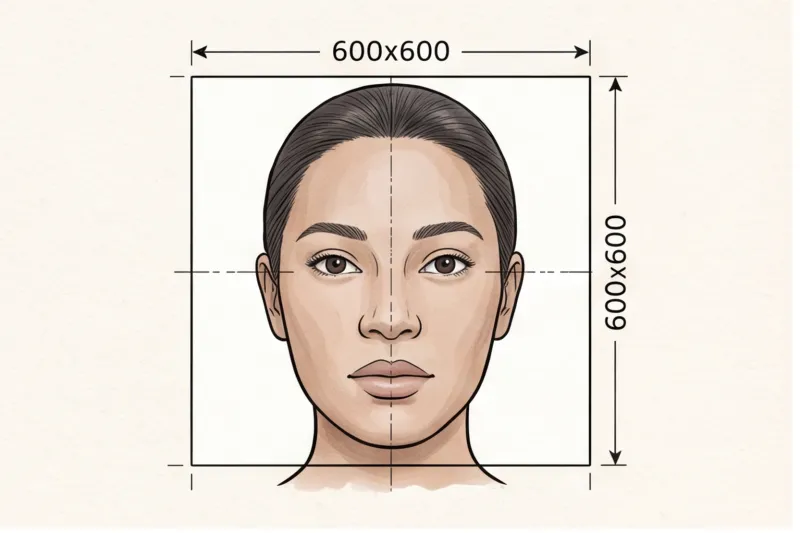
Finally, remember that there is no single global passport photo size. The required dimensions depend entirely on the country and the document type. For example, the United States Department of State requires a 2 × 2 inch (51 × 51 mm) format, while 35 × 45 mm is the standard for the UK and most of Europe. Always verify the exact measurement and head-height ratio with the specific country's official authority to ensure your final crop meets their technical requirements.
The 'Play It Safe' Accessory Checklist
The safest approach to accessories in a biometric document photo is strict minimalism: remove glasses entirely, restrict jewelry to small matte studs, and avoid bulky hair items. While specific guidelines vary by country, adhering to these baseline principles ensures your photo meets the official technical requirements without triggering a manual or automated rejection.
- Glasses: Remove them entirely. Most countries, including the United States, the United Kingdom, and the majority of the EU, now completely ban glasses in passport and ID photos to eliminate lens glare and frame obstruction. Even in regions where they might technically be permitted, removing them is our default guidance unless you have a documented medical reason and the specific country allows it.
- Earrings: Remove large hoops, chandelier earrings, or dangling pieces. If worn, keep to small, matte studs. Prominent jewelry that breaks the natural outline of the jaw or causes metallic glare is a frequent cause for application delays.
- Head coverings: These are allowed only for religious or medical reasons. If worn, the full face must remain 100% visible from the bottom of the chin to the top of the forehead. Ensure the fabric is pulled back enough so it does not cast any shadows on your cheeks or forehead. Some authorities may also require supporting documentation for these exemptions.
- Hair accessories: Avoid large bows, chunky headbands, or prominent clips. Hair and accessories must not obscure the eyes or face outline, and bulky items can easily interfere with the strict head-height ratio measurements used by border control systems.
Get your document photo in 2 minutes
Upload a normal selfie and receive a compliant document photo that meets the official technical requirements for your country and document — ready to print or submit online.
Make my photoGet a Flawless Passport Photo in Minutes
Securing a compliant document photo does not require an expensive trip to a professional studio, but it does demand technical precision. You should never risk a delayed application over a tiny jewelry reflection or an accidental shadow cast by a necklace. In our daily practice of preparing document photos, we see how strictly authorities enforce biometric standards. A minor glare from a metal stud or a faint shadow behind the ear is often enough to trigger a rejection. When this happens, authorities rarely provide detailed feedback beyond a generic "poor lighting" or "shadows present" notice, forcing you to restart the process and potentially miss crucial travel or visa deadlines.
Fortunately, achieving an acceptable image is now incredibly straightforward without leaving your house. You can confidently skip the photo studio. By following the minimal-accessory rules outlined earlier — removing your glasses, taking out large hoops or facial piercings, and ensuring your hair does not obscure your face — you have already solved the most common appearance-based rejection causes. The only remaining hurdle is getting the technical dimensions, background uniformity, and sizing exactly right.
This is where you can rely on professional tools to finish the job effortlessly. Use PhotoID24 to process your home selfie instantly. When you upload your picture, our system automatically crops it to the exact required head-height ratio and checks the technical requirements for your specific country. Because there is no single global passport photo size, manually guessing the correct crop is a major risk. Whether you are applying for a United States passport that requires a strict 2 × 2 inch (51 × 51 mm) image, or a European Union document that demands a 35 × 45 mm format, PhotoID24 applies the precise official specifications set by that country's government authority.
Furthermore, application methods vary widely depending on the document and the destination. Many countries still require identical printed photos on specific matte or glossy paper, while others now mandate digital submissions with exact pixel dimensions and strict file-size limits. Our service handles both scenarios simultaneously. After processing, you receive a professional file ready for online submission or home printing on photo paper. If you need physical prints, the resulting print sheet is perfectly aligned, ensuring no unauthorized white borders, color shifts, or scaling errors occur when you print it out.
Your single most important takeaway today is to prioritize compliance over styling. Remove any accessories that might reflect light or cast a shadow, stand one to two feet away from a plain, light background to eliminate background shadows, and look straight into the camera with a neutral expression. Once you capture that simple, evenly lit selfie, let PhotoID24 handle the complex sizing and compliance checks. You will get a photo that meets the official technical requirements in about two minutes, saving you from the stress of bureaucracy and giving you total peace of mind for your application.