Can I Wear a Hijab in a Passport Photo?
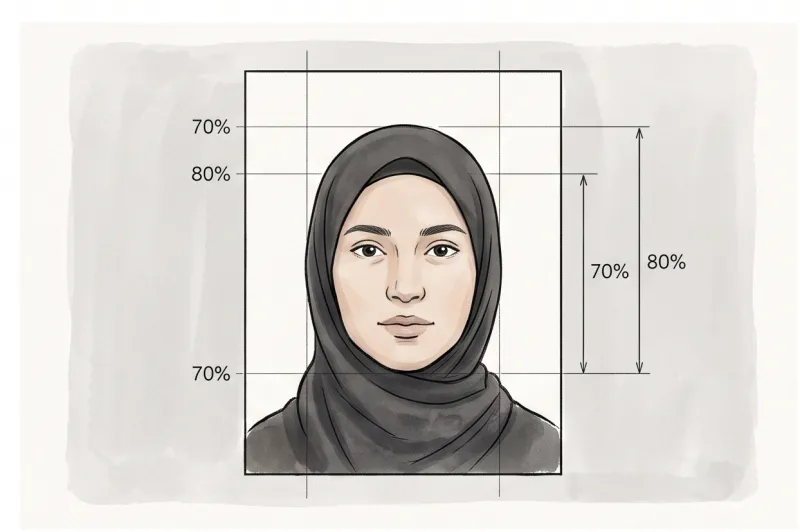
Yes, you can wear a hijab in a passport photo, provided your full face remains clearly visible. While hats and casual head coverings are strictly banned in biometric photos, authorities make a universal exception for headwear worn for religious or medical reasons.
Under the standards set by the International Civil Aviation Organization (ICAO Doc 9303) — which dictates the biometric photo rules for most of the world — a hijab is perfectly acceptable. The primary condition is that the garment must not interfere with the biometric mapping of the face. Facial recognition software measures the exact distances between your chin, nose, eyes, and forehead to verify your identity. If the fabric obscures any of these anchor points, the photo will fail the automated check.
While the technical specifications for the image itself are largely international, the documentation needed to submit a hijab passport photo can vary. We cover the full requirements across different countries in our complete guide.
As a specific example, the U.S. Department of State permits religious head coverings but requires you to submit a signed statement verifying that the item is worn continuously in public for religious purposes. Always review the exact application checklist for your specific destination, but rest assured that your religious headwear is allowed as long as the technical photo standards are met.
What Are the Rules for a Passport Picture With a Hijab?
To take a compliant passport picture with a hijab, the fabric must not cover any part of your face from the bottom of the chin to the top of the forehead. Both edges of your face and the full jawline must be clearly visible, and the head covering must not cast any shadows on your skin or the background.
These requirements exist because modern identity documents rely on precise biometric mapping. Official scanners measure the exact distances between your facial features, such as your eyes, nose, and chin. Because of this, the hijab cannot cut across your cheeks or drape over the point of your jawline. It is critical to ensure the undercap sits high enough so that your eyebrows and the full top of the forehead are exposed. Your face must be perfectly straight to the camera, aligning with the international standards covered in our complete guide.
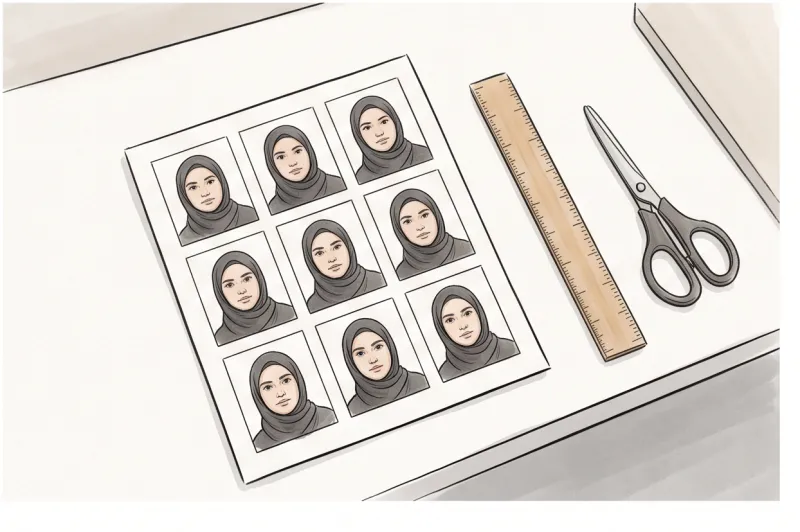
Beyond the head covering itself, universal biometric photo principles strictly apply. You must maintain a neutral expression with your mouth closed and no smile. Both eyes must be completely open, clearly visible, and looking directly into the camera lens. Your head and shoulders must be completely level without any tilt.
When selecting your hijab for the photo, pay close attention to color and pattern. While official authorities do not usually dictate the color of religious headwear, wearing a plain, solid color is highly recommended. The fabric should contrast slightly against the mandatory plain, light background (which is typically white or light grey, depending on the country). Avoiding complex patterns or heavily textured fabrics ensures a clean outline for the cropping process.
Finally, even lighting is crucial. In practice, the drape or peak of a hijab frequently casts harsh shadows over the forehead, the side of the cheeks, or the wall behind the head. Uneven lighting is a top rejection reason. You must use balanced light to eliminate all shadows, ensuring natural skin tones and a clearly visible facial outline.
Get your document photo in 2 minutes
Upload a normal selfie and receive a compliant document photo that meets the official technical requirements for your country and document — ready to print or submit online.
Make my photoWhat Will Get a Passport Photo Rejected When Wearing a Head Covering?
A passport photo with a head covering will be rejected if the fabric casts shadows on the face, obscures the eyebrows or jawline, or if the background is not plain. Even minor biometric mismatches caused by styling choices, wearing glasses, or using digital filters lead to immediate application denials.
In practice, the most frequent reason a hijab passport photo fails is uneven lighting caused by the fabric's drape. The peak of a hijab or voluminous folds around the neck often cast distinct shadows across the forehead or cheeks. Border-control biometric scanners rely on measuring the exact distances between your facial features. If a shadow obscures the true edge of your jawline or creates a false contour on your cheek, the software cannot map your face correctly, resulting in a biometric mismatch and rejection.
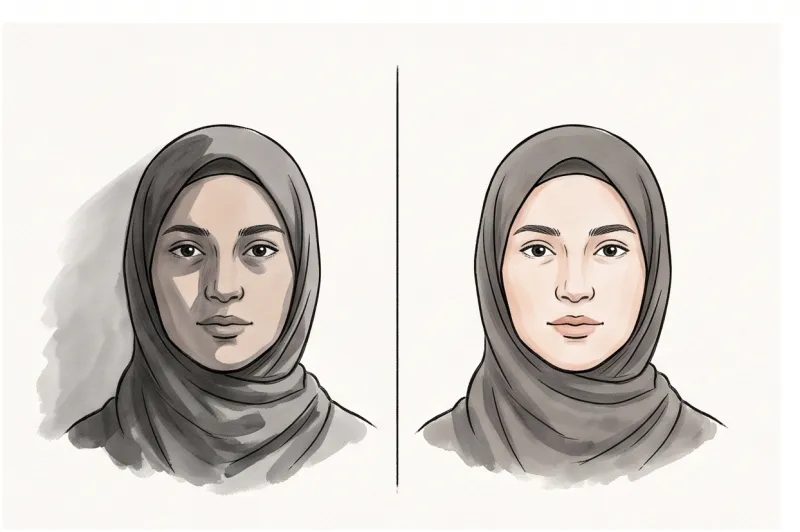
Another common mistake is over-coverage. Pulling an undercap down too far so it touches or covers the eyebrows violates the full-face visibility rule. Similarly, wrapping the hijab tightly over the point of the chin hides the lower boundary of the face. The international standard demands your face be entirely visible from the very bottom of the chin to the upper forehead.
Even if your hijab is perfectly positioned, wearing glasses is a major rejection trigger. Many authorities — including the US Department of State and most EU and UK passport offices — now ban glasses entirely in biometric photos. Unless you hold a documented medical exemption that the specific country permits, you must remove your glasses to prevent lens glare and frame obstruction.
Your background must be strictly plain, light, and uniform (typically white or light grey, depending on the country). Additionally, avoid heavily textured or intensely patterned hijab fabrics. While authorities do not dictate the head covering's colour, busy patterns can confuse the automated cropping tools used by government systems to separate your silhouette from the background.
Finally, any digital manipulation is strictly forbidden. Applying filters, skin-smoothing tools, or other beautification features alters your natural appearance and guarantees an automatic rejection. The photo must be an accurate, unedited representation of you.
What Are the Passport Photo Requirements for Makeup?
Makeup is permitted in a passport photo, provided it reflects your natural, everyday appearance and maintains your true skin tones. The fundamental rule is that your face must be an accurate, true-to-life representation of how you look on a daily basis, rather than a glamour portrait.
In practice, the most common makeup-related issue we see is heavy contouring. Biometric systems verify your identity by measuring the exact distances between your facial features, such as the space between your eyes, the width of your nose, and the structure of your chin. Using heavy contouring or highlighting to alter the apparent shape of your face disrupts this biometric mapping. If the scanner reads a different facial structure than your actual physical features, the biometric verification will fail.
You must also avoid glitter or highly reflective makeup. Under a camera flash or bright lighting, glossy lipsticks and shimmering highlighters create localized glare and uneven lighting across the skin. Since even lighting is a strict biometric requirement, any bright reflections will cause the photo to be rejected. Stick to matte finishes to ensure the light distributes evenly.
Finally, the requirement for a true-to-life image extends to how the photo is processed. There is a strict, universal ban on digital beautification, filters, and heavy retouching. While applying light makeup to cover a temporary blemish is perfectly fine, using software to smooth your skin or reshape your face violates official standards and guarantees rejection.
Ready to prepare your document photo?
Skip the studio. Upload a selfie and get a professionally prepared photo that meets the official technical requirements in about two minutes.
Get startedHow to Take a Hijab Passport Photo at Home (Privacy & Comfort)
Taking your passport photo at home allows you to control your environment, offering the privacy and comfort to arrange your hijab properly without the pressure of a public photo booth or a busy photography studio. For Muslim women, a home setting removes the stress of adjusting headpieces in public spaces while ensuring the final image meets strict biometric standards.
The most critical element of a home setup is even lighting. The folds and drapes of a hijab can easily cast dark shadows across your neck, cheeks, or forehead, which is a leading cause of photo rejection. To prevent this, set up your camera directly facing a window to take advantage of natural, diffused daylight. Stand about half a metre away from a plain white or light grey wall. This specific distance allows the light to wrap around you, eliminating harsh drop shadows on the background behind your head.
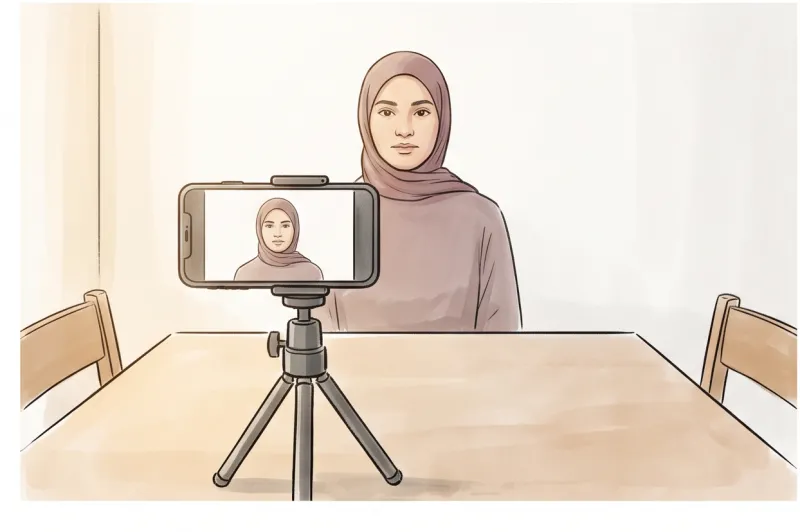
Never submit a selfie for an official document. A camera held at arm's length distorts facial proportions, often enlarging the nose and altering the shape of the jawline, which causes the biometric software to fail. Instead, place your smartphone on a tripod at eye level, or ask a friend or family member to take the photo from about 1.5 metres away. Keep your shoulders square, look straight into the lens, and maintain a neutral expression.
Once you have captured a well-lit image, you do not need to worry about the technical editing. By using our professional service, PhotoID24, you simply upload your standard photo. The system checks it against official biometric rules, removes non-compliant backgrounds, and formats the image for your required country and document in minutes, ready for digital submission or printing.
How Do I Make a 2x2 Photo for My Passport?
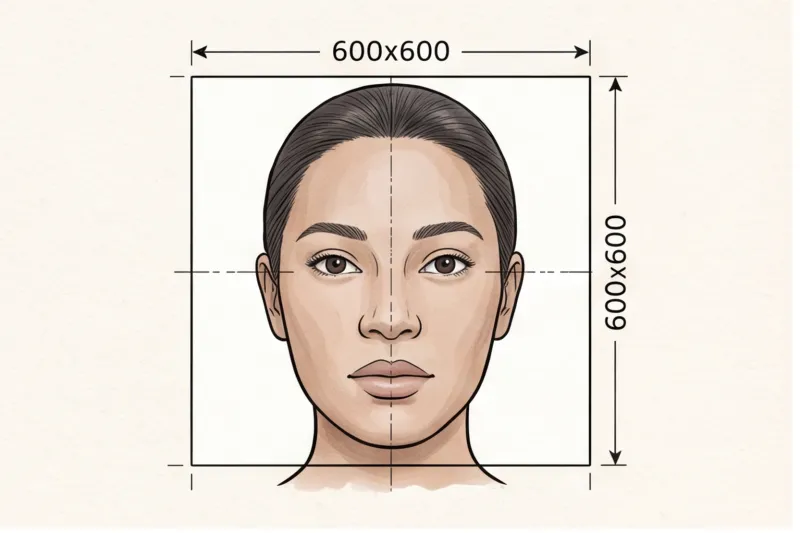
There is no single global passport photo size, meaning you only need a 2 × 2 inch (51 × 51 mm) photo if you are applying for specific documents, such as a United States passport or an Indian visa. Many applicants mistakenly assume the American size is a universal standard, leading to immediate rejection when applying for other countries.
In contrast, most of Europe, the UK, and Australia require a 35 × 45 mm format, alongside different background rules and framing proportions. Because these specifications are exact, you should never try to guess the size or manually crop the image yourself using generic desktop software.
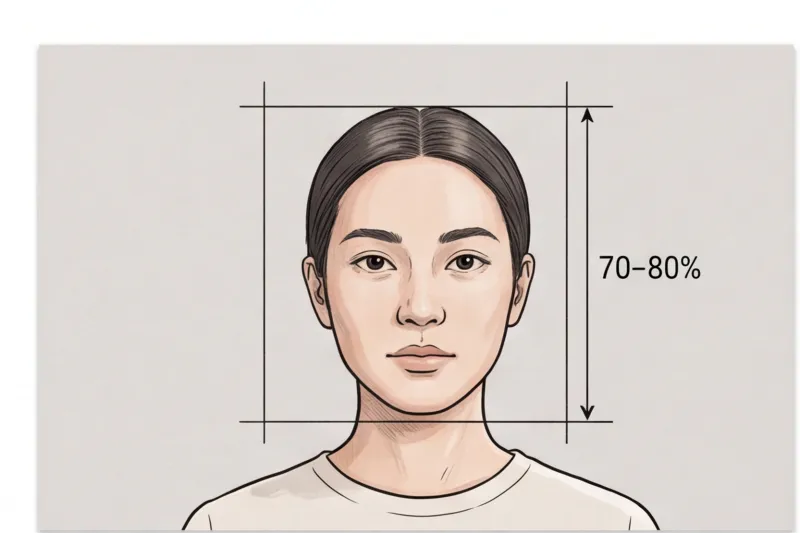
Instead of struggling with pixel dimensions and aspect ratios, rely on the official requirements for your specific destination. Using PhotoID24 ensures that the correct physical dimensions, the appropriate background specifications, and the precise head-height ratio — such as your face filling exactly 70–80% of the frame — are automatically applied based on the exact country and document you select.
Checklist: Preparing Your Hijab for a Biometric Photo
To ensure your photo meets official biometric standards, your final preparation must secure the hijab so that your full jawline is visible, clear the undercap above your eyebrows, eliminate all fabric shadows, and use a plain, contrasting colour. Missing just one of these technical details is a frequent cause for application delays. Before you take your picture, review this practical checklist to verify your styling aligns with standard biometric requirements.
- Pin the hijab securely behind the ears or tightly under the chin so the full jawline is visible. Biometric mapping software calculates the precise distance between your facial features, including the width of your face and the shape of your jaw. In practice, loosely draped styles or voluminous wraps often cut across the cheeks or hide the chin. Pin the fabric back firmly to ensure both edges of your face are fully exposed from the bottom of the chin to the top of the forehead. Note that excessively voluminous styles can also distort the head-height measurement required by the authorities.
- Ensure the undercap sits above the eyebrows. Eyebrows are a primary anchor point for facial recognition algorithms. Pull your undercap back carefully so that the entirety of both eyebrows is completely visible. If the fabric rests on or dips below the brow line, the scanner will fail to register your facial proportions accurately.
- Check that no part of the fabric casts a shadow on your forehead, cheeks, or neck. Uneven lighting is one of the most common reasons a photo is rejected. A prominent peak at the forehead or deep folds around the neck can easily block light. Adjust your lighting so it hits your face directly and evenly, ensuring no dark patches fall on your skin or on the plain light background behind your head.
- Choose a solid, plain-colored hijab that contrasts with a light background. Because most countries strictly mandate a plain white or light grey background, wearing a white hijab can cause your outline to blend into the wall. This makes it difficult for automated systems to crop the image correctly. Select a solid, darker tone without patterns, heavy textures, or reflective embellishments.
- Maintain a neutral expression, look straight at the lens, and ensure both eyes are wide open. Keep your head perfectly level and centred, with your shoulders square to the camera. Do not tilt your head to adjust for hijab folds. Your mouth must remain closed without smiling, and both eyes must be clearly visible, looking directly at the camera lens. If you normally wear glasses, remember that many countries now ban them entirely in passport photos; remove them unless you hold a specific, documented medical exemption.
Your immediate next step today is to do a quick test shot. Stand about half a metre in front of a plain wall, facing a window for even natural light. Arrange your hijab according to this checklist and take a practice photo to check for shadows and facial visibility.
Once you have a clear, well-lit image, you do not need to worry about manually cropping it to the exact head-height ratio or figuring out whether you need a 35 × 45 mm format (common in Europe and the UK) or a 2 × 2 inch (51 × 51 mm) size for the United States. A professional service will handle the strict technical formatting for your specific destination.
Get your document photo in 2 minutes
Upload a normal selfie and receive a compliant document photo that meets the official technical requirements for your country and document — ready to print or submit online.
Make my photo