Can You Wear Glasses in a Passport Photo?
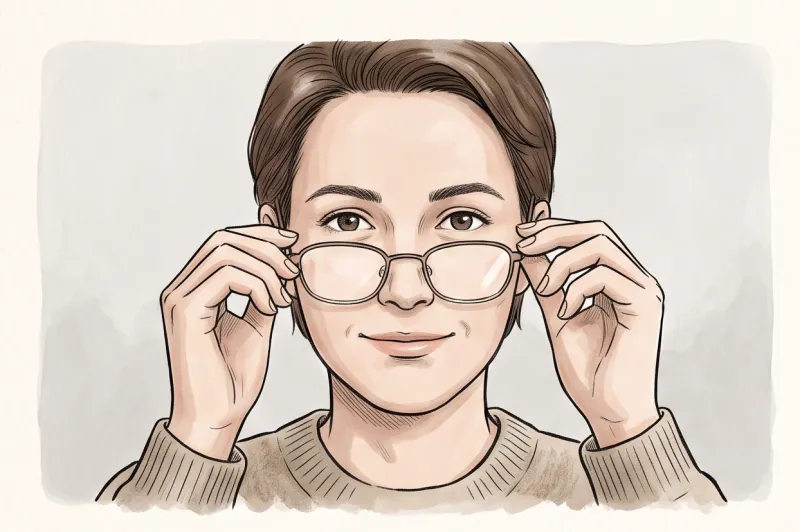
If you are wondering whether you can wear glasses in a passport photo, the definitive answer for most major countries is a strict no. Removing your spectacles is the only reliable way to ensure your image meets official biometric standards without risking a rejected application.
Since 2016, the U.S. Department of State has completely banned glasses for all passport and visa applications. The UK takes a similarly strict stance; while GOV.UK rules note they might be permissible if there is zero glare, the primary guidance strongly advises taking them off entirely to avoid processing delays.
This widespread ban stems from the biometric guidelines outlined in ICAO Doc 9303, the international standard for machine-readable travel documents. Security software relies heavily on mapping the exact distance between your eyes and the structure of your iris. Because of this, the default global guidance is to remove your glasses to guarantee your photo meets the official technical requirements, even if your destination country has not issued a total ban.
In the few instances where a specific authority technically allows them, the rules are unforgiving. There must be absolutely no glare or reflection on the lenses, no tinted glass, and the frames cannot cover any part of your eyes or cast shadows on your face. Rather than risking a ruined application over a minor flash reflection, taking them off is always the best approach.
Why Are Glasses Increasingly Banned in Passport Photos?
Glasses are being banned globally because modern travel documents have transitioned from simple visual identification to automated biometric facial recognition. To ensure that electronic border systems function without error, the international specification for machine-readable travel documents—ICAO Doc 9303—heavily discourages any accessory that might obstruct clear visibility of the core facial features.
In the past, a human border officer simply compared your physical face to the printed photo. Today, electronic passport gates (e-gates) use advanced cameras to mathematically map your facial geometry. These biometric scanners focus primarily on the ocular region. They calculate the precise distance between your eyes and analyze the detailed, unique structures of the iris and pupil to verify your identity.
Because the security system relies on extracting these exact nodal points, wearing glasses introduces a high risk of interference. In practice, we see photos routinely rejected because even a minor reflection on the lens from a studio flash, or a faint shadow cast by a seemingly thin frame, alters the geometry the scanner perceives. If a frame crosses the eye orbit in the slightest, it ruins the digital scan. When an e-gate scanner cannot read the exact outline of your eye, the automated check fails. This directly leads to automatic border control delays, forcing travelers out of the quick automated lane and into long queues for manual processing by a border agent.
Get your document photo in 2 minutes
Upload a normal selfie and receive a compliant document photo that meets the official technical requirements for your country and document — ready to print or submit online.
Make my photoCountry-Specific Rules: Where Are Glasses Allowed or Banned?
Whether you can wear glasses in a passport photo depends entirely on the country issuing the document. While the international biometric standard (ICAO Doc 9303) theoretically permits glasses, many national authorities have enacted outright bans to streamline automated border checks. Because requirements differ drastically by destination, you must always check the official guidelines for your specific document before applying.
In our experience preparing document photos globally, the most practical approach is universal: even if a country technically allows glasses, removing them is the safest way to guarantee your photo meets the official technical requirements and to avoid unexpected processing delays.
United States and United Kingdom
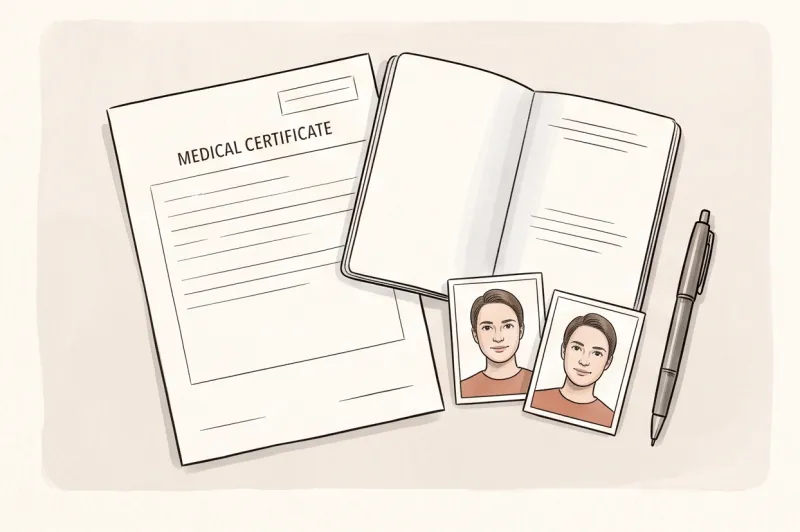
For the United States, the U.S. Department of State has completely banned glasses for all passport and visa applications since 2016. Whether you are submitting a digital file or a printed 2 × 2 inch (51 × 51 mm) photograph, spectacles are strictly prohibited. The only exception is a documented medical necessity, such as recent ocular surgery, which requires a signed statement from a medical professional submitted alongside your application. Without this medical documentation, any U.S. application featuring glasses will be rejected immediately.
In the United Kingdom, the official GOV.UK rules are slightly more lenient but lead to the same practical conclusion. You are technically allowed to wear glasses for a UK passport photo, provided there is no glare on the lenses and the frames do not obscure your eyes in any way. However, GOV.UK default guidance strongly advises applicants to remove them entirely. Even a minor reflection from a nearby window or room lighting can cause a digital photo check to fail, making removal the smartest option to avoid having to retake the image.
European Union and Other Regions
Across the European Union and the Schengen Area, where the standard biometric photo size is typically 35 × 45 mm, wearing glasses is heavily discouraged by national ministries of interior. If you choose to wear them, the margin for error is essentially zero. There must be absolutely no flash reflection on the glass, lenses cannot be tinted or photochromic (transition lenses), and the frames must be thin enough that they do not cover any part of the eye orbit or cast shadows onto your cheeks.
Other major immigration authorities, including those in Australia, Canada, and India, enforce similarly strict restrictions. Because perfectly lighting a subject who is wearing glasses is technically challenging — often resulting in uneven light or hidden eye contours — we recommend removing them universally. Taking your photo without glasses is the easiest way to ensure full compliance, save time, and prevent frustrating application rejections.
Medical Exceptions: What If You Cannot Remove Your Glasses?
Yes, you can keep your glasses on if you have a documented medical necessity, such as recent eye surgery or severe light sensitivity. However, this requires an official medical statement, and the photo itself must still pass strict biometric visibility checks.
While the standard mandate across most authorities is to remove eyewear, exceptions are made for genuine health conditions. In practice, the procedure usually requires you to submit a signed, written statement from a licensed medical professional along with your document application. Because these exception protocols are not universal, always check the exact documentation required by your specific destination's official authority — such as the U.S. Department of State or your national passport office — rather than assuming a generic rule applies.
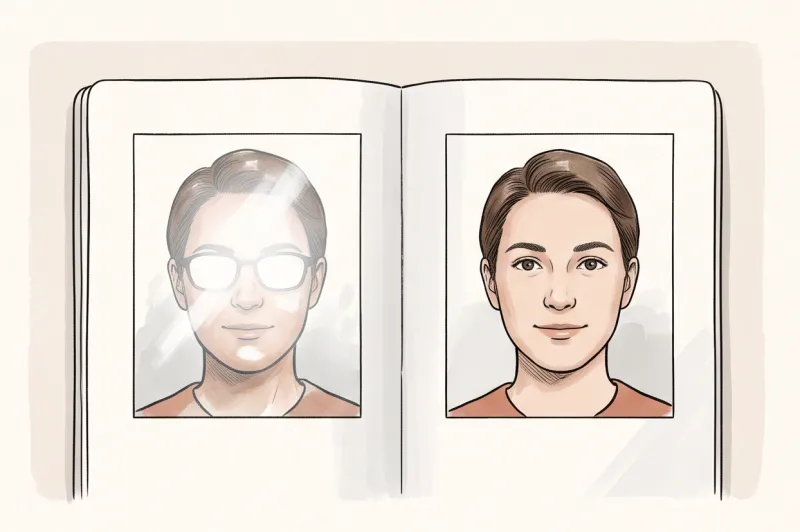
Crucially, a medical exception waives the ban on wearing physical glasses, but it does not waive the technical quality requirements. Even with a doctor's note, your eyes must remain completely visible. There can be absolutely no glare or reflection on the lenses, and the frames must not cross the eye orbit, cast shadows, or obscure your pupils. If the biometric scanner cannot clearly read your eyes, the application will be rejected regardless of medical necessity.
Ready to prepare your document photo?
Skip the studio. Upload a selfie and get a professionally prepared photo that meets the official technical requirements in about two minutes.
Get startedTop Reasons Glasses Cause Passport Photo Rejections
In practice, glasses cause passport photo rejections primarily because they introduce glare, obscure the eye socket with thick frames, or alter your natural eye color. Even in countries that technically permit eyewear, the strict biometric scanning requirements mean the slightest visual obstruction will fail the automated checks.
If you wear glasses where allowed, these are the exact technical failures that most frequently trigger an automatic rejection:
- Glare and reflections: This is the single most common failure, caused by both studio flashes and bright home lighting. Even if your lenses seem clear to the naked eye, direct light easily bounces off the glass. In our daily photo practice, we frequently observe that anti-glare coatings do not solve this; under a direct flash, anti-glare glasses often reflect a prominent green or purple hue, leading to immediate rejection by the passport authority.
- Frames covering the eyes: Biometric software needs to map the exact distance between your eyes and the shape of the eye orbit. Thick frames that cross over the eye line, cover the pupil, or cast harsh shadows across the surrounding skin will disrupt this data and invalidate the image.
- Tinted and transition lenses: Darkened lenses that obscure your natural eye color are universally prohibited. Transition (photochromic) lenses are a frequent trap because they naturally darken in response to bright studio lighting or window light, instantly ruining the photo.
- Red-eye effect: Using a flash to overcome lighting issues often results in the red-eye effect. Because international standards strictly ban any digital manipulation or retouching, you cannot simply edit out the red-eye to fix the image. The photo must be entirely retaken.
How to Take a Compliant Passport Photo at Home
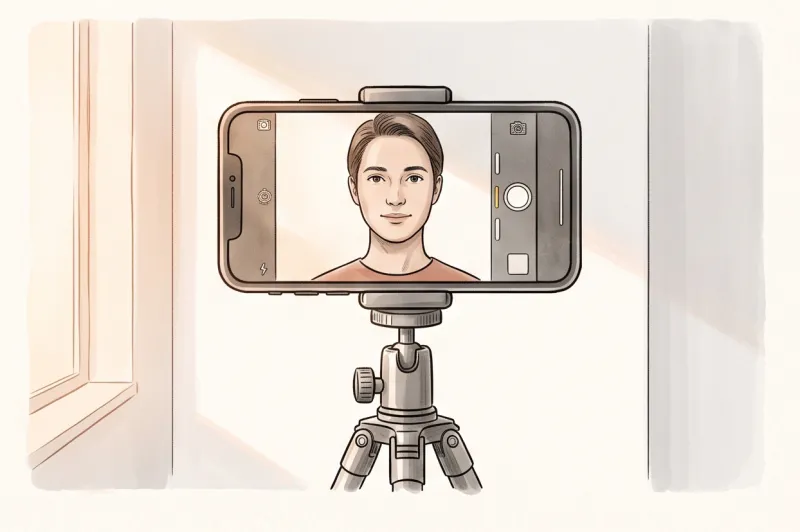
To take a compliant passport photo at home, position yourself facing a natural light source, stand against a plain, light background, and maintain a neutral expression with your head centered. Capturing the correct lighting and pose ensures your biometric features are fully visible without introducing the shadows that frequently cause applications to fail.
In practice, a typical mistake when shooting at home is relying on overhead ceiling lights. These cast deep, harsh shadows under your eyes and chin, which biometric scanners cannot process correctly. Instead, stand about an arm's length away from a window, facing it directly. This floods your face with even, natural light and drastically reduces the risk of glare on your skin or lenses — crucial whether you are in a jurisdiction that permits glasses or you have removed them.
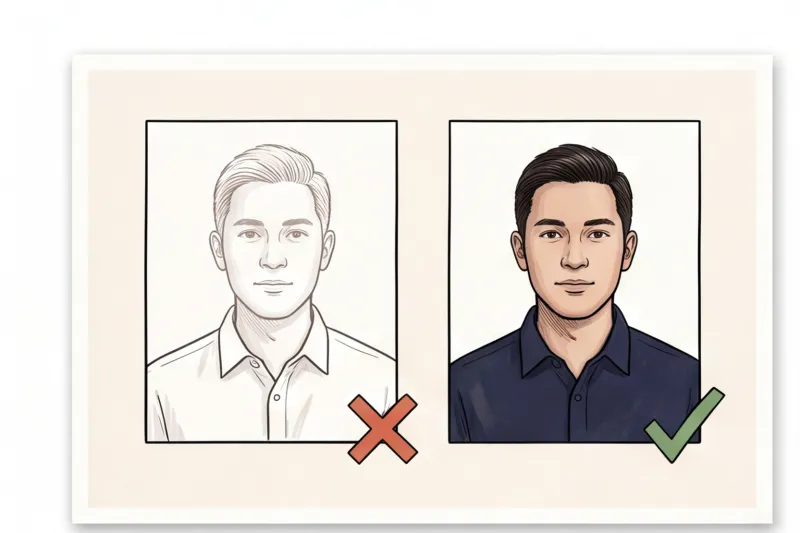
Set up against a plain, light, uniform background — white or light grey is the standard for most authorities. Ensure there are no patterns, objects, or visible drop shadows behind your head. Keep the camera exactly at eye level to prevent any chin tilt. Your posture must be straight, with shoulders square and your head perfectly centered. Maintain a strict, neutral expression: mouth completely closed, no smile, and both eyes open, looking straight into the lens.
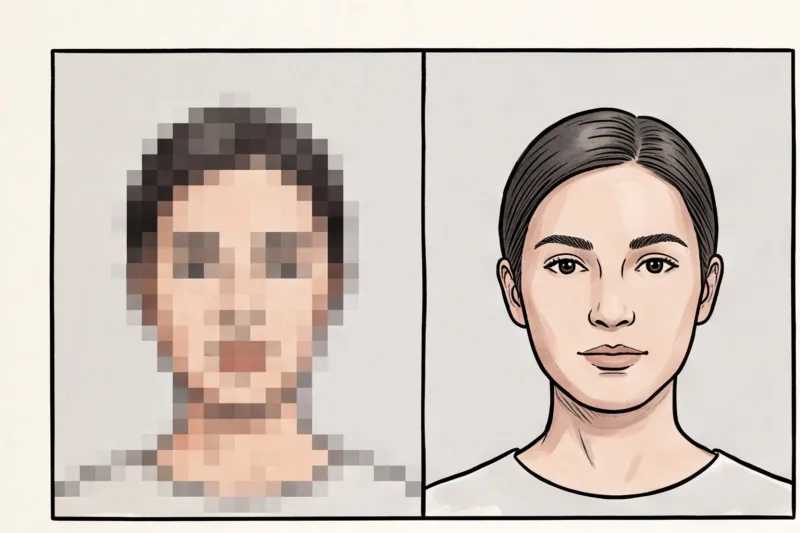
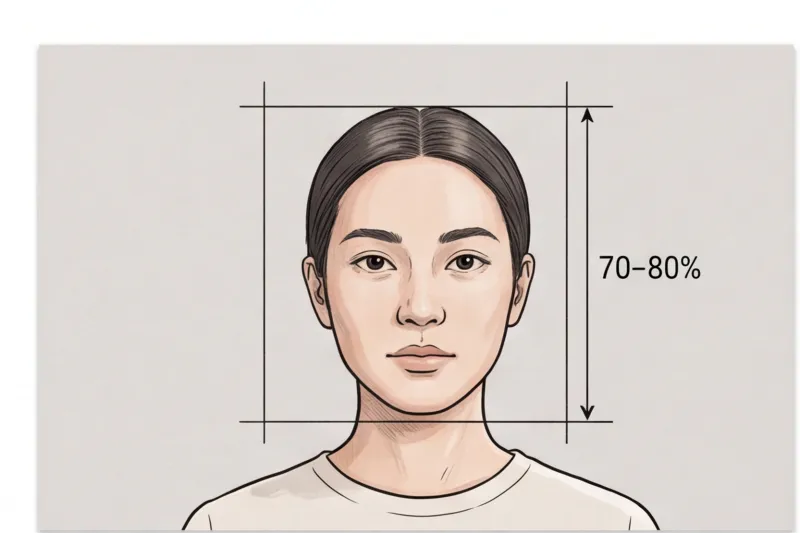
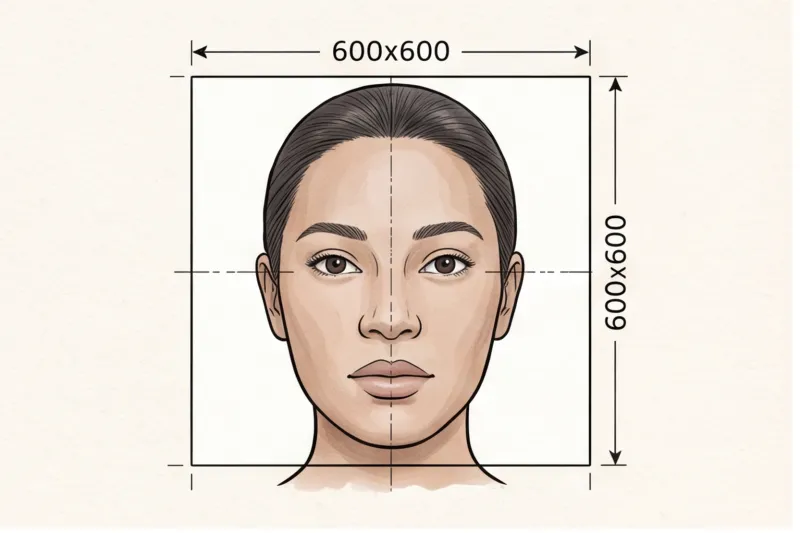
Getting the lighting and pose right is the most important step; formatting the final file is something we can handle for you. With our professional service, PhotoID24, there is no need to manually calculate head-height ratios or struggle with complex editing software. Simply upload your well-lit selfie, and our automatic system verifies it against the official biometric rules. We instantly crop it to the exact required size for your specific document — such as the 35 × 45 mm format common in Europe or the 2 × 2 inch (51 × 51 mm) standard for the United States — and prepare it for digital submission or print in minutes.
Get your document photo in 2 minutes
Upload a normal selfie and receive a compliant document photo that meets the official technical requirements for your country and document — ready to print or submit online.
Make my photoFrequently Asked Questions About Eyes in Document Photos
When preparing a biometric document photo, your eyes are the single most critical feature analyzed by border control systems. The direct answer to most eye-related queries is simple: clear contact lenses are permitted, but anything that alters or obscures your natural eye appearance — including colored contacts, sunglasses, or tinted lenses — is strictly banned.
Can I wear contact lenses in my passport photo?
Yes, you can wear standard contact lenses, provided they are completely clear. There is a common misconception that all contact lenses alter the appearance of your iris and will confuse facial recognition software. In reality, biometric scanners map the precise structure of your iris and measure the distance between your pupils. Standard clear prescription contacts do not interfere with this data capture.
However, colored contacts or circle lenses (which artificially enlarge the iris) are strictly prohibited. These lenses mask the very biometric data that modern e-passports require. In practice, attempting to wear colored contacts will result in an immediate rejection because the photo no longer accurately represents your natural eye color and shape. If you normally wear colored lenses, you must remove them before taking your photo.
Can I wear sunglasses or tinted lenses?
No, sunglasses and tinted prescription lenses are universally prohibited. Following the international biometric standards outlined in ICAO Doc 9303, national authorities require your eyes to be fully visible with no shadows, glare, or color distortion.
A typical mistake when shooting a passport photo at home or outdoors is wearing photochromic (transition) lenses. Because these lenses automatically darken when exposed to UV light, they can create a slight tint that obscures the eye socket. Even a minor 10% tint will cause a rejection. Your best course of action is to remove your glasses entirely.
What if my photo with glasses was accepted previously?
Rules change, and relying on past success is a fast track to a delayed application. For example, the U.S. Department of State officially banned all glasses in passport and visa photos in 2016, ending decades of leniency. Similarly, many European authorities now heavily discourage or outright ban glasses to streamline automated border checks.
More importantly, a universal rule across almost all jurisdictions is that your photo must be recent — typically taken within the last 6 months. You cannot simply submit a reprint of the older photo that was previously accepted. The image must reflect your current appearance and comply with today’s strict biometric standards.
Your Next Step: Getting a Compliant Photo Today
The rules surrounding glasses and eye visibility are rigid, but getting a correct photo does not have to be stressful. The most actionable step you can take today is to remove your glasses, ensure your eyes are clearly visible, and take a fresh photo that meets current regulations.
Instead of guessing whether your home photo has the right crop or lighting, you can use our professional service at PhotoID24. Simply upload a standard selfie taken against a plain, light background. Our system automatically processes your image, verifies it against the official technical requirements for your specific country and document, and crops it to the exact required dimensions. In just minutes, you will have a fully compliant photo ready for digital submission or printing, ensuring your application proceeds without unnecessary delays.