Mali document photos online
Every Mali document photo format: Passport, National ID card, Visa, Residence card and 2 more. Compare all 6 official sizes and make the one you need from a selfie — preview free.
Requirements verified: 23.09.2026
Compare formats
| Document | Size | Background | Glasses | Headwear | File |
|---|---|---|---|---|---|
| Driving licence | 35 × 45 mm | White plain | Allowed | Only for religious reasons | JPG · ≤ 500 KB |
| National ID card | 35 × 45 mm | White plain | Allowed | Only for religious reasons | JPG · ≤ 500 KB |
| Passport | 35 × 45 mm | White plain | Allowed | Only for religious reasons | JPG · ≤ 500 KB |
| Residence card | 35 × 45 mm | White plain | Allowed | Only for religious reasons | JPG · ≤ 500 KB |
| Visa | 35 × 45 mm | White plain | Allowed | Only for religious reasons | JPG · ≤ 500 KB |
| Work permit | 35 × 45 mm | White plain | Allowed | Only for religious reasons | JPG · ≤ 500 KB |
Need a document photo for Mali? Below are all 6 formats we prepare for Mali (Passport, National ID card, Visa, Residence card and 2 more) — each made from your selfie to the exact official size, background and head proportions.
Use the comparison table to check the size, background colour and rules (glasses, headwear) for every Mali document at a glance, then open the one you need. Each format shows a free watermarked preview first; you pay only for the final file.
Did you know? Mali
Long before the modern passport existed, Mali set the gold standard for global wealth. In 1324 the emperor Mansa Musa left Mali on the Hajj to Mecca with a caravan of tens of thousands of people and camels loaded with gold dust, and gave away so much of it in Cairo that he reportedly crashed the city's gold price for years. His empire controlled much of the medieval world's gold supply and turned Timbuktu into a university town whose libraries held hundreds of thousands of manuscripts. Today the same nation carries one of West Africa's more travel-restricted passports, a striking reversal of fortune across seven centuries.
- Passport power The Malian passport ranks 79th on the Henley Passport Index, giving its holders visa-free or visa-on-arrival access to just 53 destinations worldwide.
- Own currency After independence Mali ditched the shared CFA franc and printed its own Malian franc from 1962, but inflation forced a 50% devaluation in 1967, and in 1984 it crawled back into the CFA zone at a humbling 2 old Malian francs to 1 CFA franc.
- Euro-pegged Mali pays in West African CFA francs that are not freely floating at all — the currency is pegged to the euro at a fixed 655.957 CFA per €1, so Malians effectively carry money tied to Frankfurt.
- Richest ever Mali's 14th-century ruler Mansa Musa is frequently cited as the wealthiest individual in human history, his fortune resting on control of much of the era's gold trade.
- Two birthdays Mali briefly shared statehood with Senegal: the Mali Federation became independent on 20 June 1960, but after Senegal split away the Sudanese Republic re-declared itself the Republic of Mali on 22 September 1960 — the date Malians now mark as Independence Day.
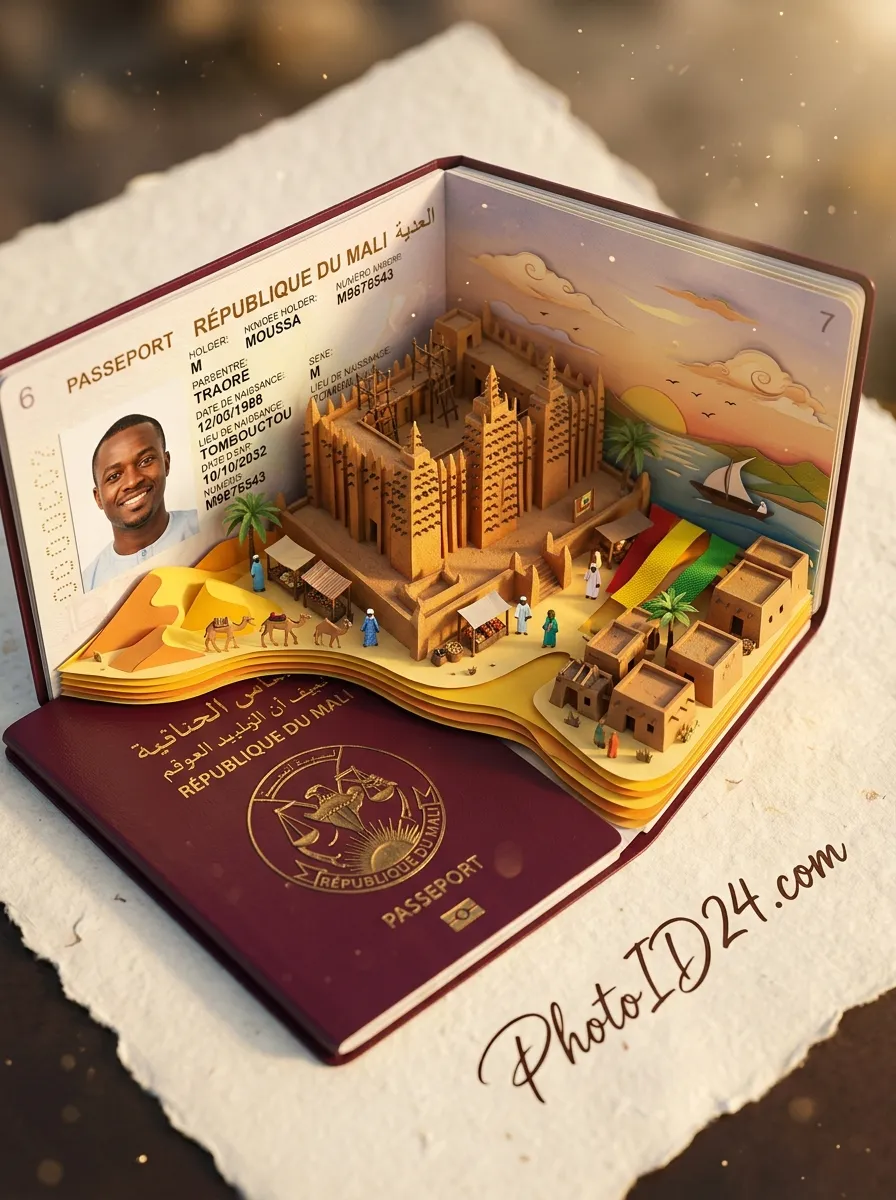
- Mud landmark The Great Mosque of Djenne is the largest mud-brick building on Earth, and the whole town turns out each year before the rains to re-plaster it by hand in a festival called the Crepissage.
- Salt money In the Saharan north, Tuareg camel caravans still haul roughly 90-kilogram slabs of salt from the Taoudenni mines toward Timbuktu — salt that was once traded ounce-for-ounce against gold.
- Manuscript city Timbuktu's scholarly tradition predates Europe's great universities, with surviving family libraries safeguarding hundreds of thousands of medieval manuscripts on law, astronomy and medicine.
Sources: Visa requirements for Malian citizens — Wikipedia · Henley Passport Index · Malian franc — Wikipedia · West African CFA franc — Wikipedia · Musa I of Mali — Britannica · Mali Federation — Britannica · Great Mosque of Djenne — religionunplugged.com · Taoudenni — Wikipedia · Mali Population — World Population Review