Switzerland document photos online
Every Switzerland document photo format: Passport, National ID card, Visa, Residence card and 2 more. Compare all 6 official sizes and make the one you need from a selfie — preview free.
Requirements verified: 23.09.2026
Compare formats
| Document | Size | Background | Glasses | Headwear | File |
|---|---|---|---|---|---|
| Driving licence | 35 × 45 mm | Light plain | Allowed | Only for religious reasons | JPG · ≤ 2 MB |
| National ID card | 35 × 45 mm | Light plain | Allowed | Only for religious reasons | JPG · ≤ 2.4 MB |
| Passport | 35 × 45 mm | Light plain | Not allowed | Only for religious reasons | JPG · ≤ 2 MB |
| Residence card | 35 × 45 mm | Light plain | Allowed | Only for religious reasons | JPG · ≤ 2.4 MB |
| Visa | 35 × 45 mm | Light plain | Allowed | Only for religious reasons | JPG · ≤ 120 KB |
| Work permit | 35 × 45 mm | Light plain | Allowed | Only for religious reasons | JPG · ≤ 2 MB |
Need a document photo for Switzerland? Below are all 6 formats we prepare for Switzerland (Passport, National ID card, Visa, Residence card and 2 more) — each made from your selfie to the exact official size, background and head proportions.
Use the comparison table to check the size, background colour and rules (glasses, headwear) for every Switzerland document at a glance, then open the one you need. Each format shows a free watermarked preview first; you pay only for the final file.
Did you know? Switzerland
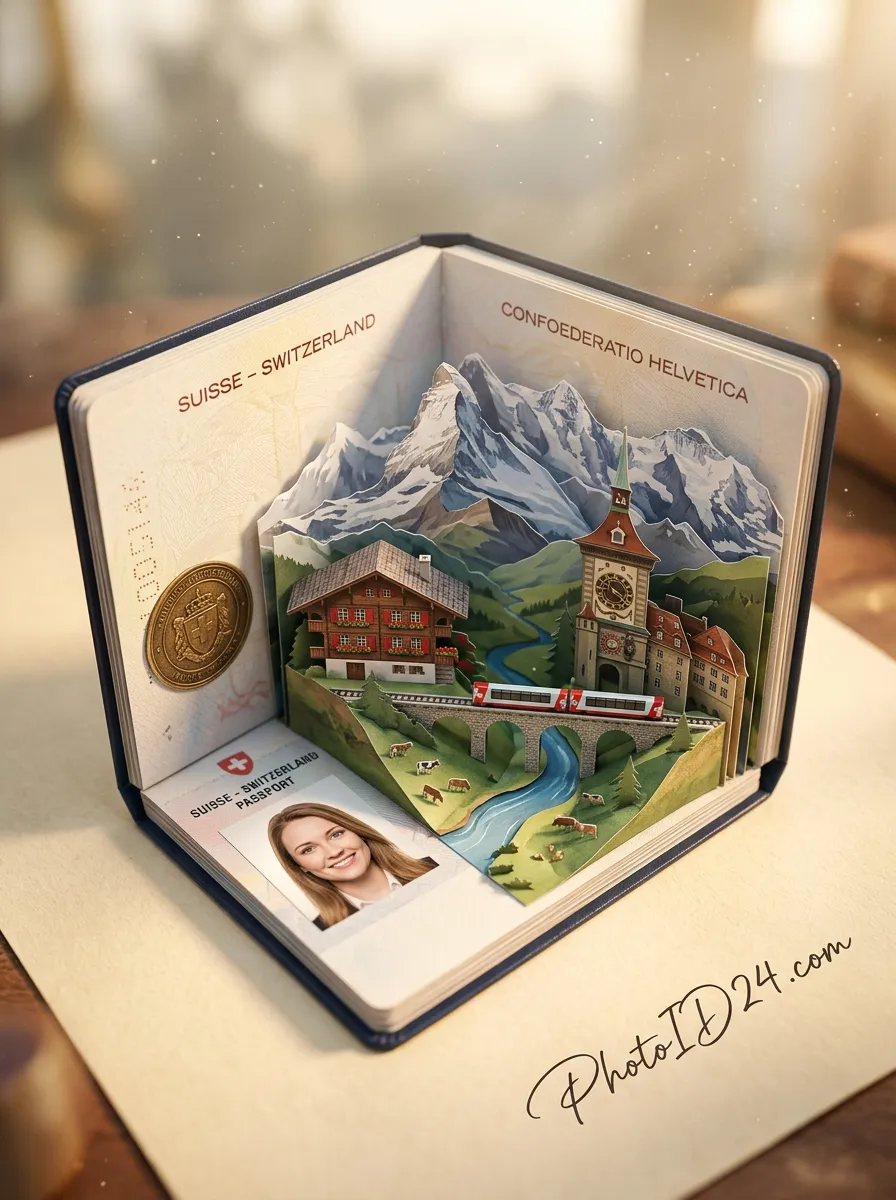
Look closely at a Swiss passport and you find a quiet rebellion against the rest of the world's documents: where most passports record where you were born, the Swiss one records your place of origin, the ancestral municipality and canton your family belongs to, even if you have never lived there. The pages carry an incomplete Swiss cross that only closes into a whole when held to the light against its mirror on the reverse, and every one of the 26 cantons gets its own page of mountains and waterways. Identity here is rooted in lineage and landscape, not the hospital you happened to arrive in.
- Passport design The Swiss passport lists your place of origin, the ancestral municipality and canton your family is registered in, instead of your place of birth, which most other countries print.
- Security feature Each page bears an incomplete Swiss cross that only forms a complete cross when held to the light, lining up with its mirror image printed on the reverse side.
- Passport power As of 2025 the Swiss passport gave visa-free or visa-on-arrival access to 190 destinations, placing it around fifth in the world on the Henley Passport Index.
- Citizenship In many Swiss municipalities naturalisation has historically been decided by the local community itself, sometimes by a vote of residents, making fellow townspeople the gatekeepers of becoming Swiss.
- Currency The franc arrived in 1798 with Napoleon's Helvetic Republic, and its code CHF stands for Confoederatio Helvetica, the Latin name that lets a four-language nation avoid choosing one tongue.
- Banknotes Switzerland prints a 1,000-franc note worth roughly a thousand dollars, one of the most valuable banknotes in regular circulation anywhere, and it makes up the majority of all Swiss cash by value.
- The rappen The franc's hundredth part, the rappen, traces its name to a medieval coin from Freiburg whose eagle was later mistaken for a raven, which is exactly what Rappen means in German.
- Founding Switzerland traces its origin to a Federal Charter of 1291 sworn by three valley communities, a document that was largely forgotten and only rediscovered in a Schwyz archive in 1758.
- Languages An earlier edition of the Swiss passport printed text in 26 languages across its pages; the current version trims this back to the four national languages plus English.
Sources: Swiss passport — Wikipedia · Swiss franc — Wikipedia · Rappen — Wikipedia · Federal Charter of 1291 — Swiss government (admin.ch) · Henley Passport Index · The 1000-franc note — SWI swissinfo.ch · Foreign resident population — migration.swiss · Democratising Switzerland (naturalisation) — Verfassungsblog